Blog
AI Is Making Task Lists Obsolete: The Shift From Project Management to Work Stations
Olivia Parkes
10 minutes
Last Tuesday, I watched a marketing director panic.
Her team spent 6 hours creating one client newsletter. They had tasks for ideation, drafting, review, edits, approval—the whole assembly line.
I pulled up a work station we'd built for another agency. Generated 8 newsletters in 90 minutes. Same quality. Different structure.
She asked: "What happens to all our tasks?"
That's the question everyone should be asking right now.
The Fundamental Shift
Your project management tool was built for a world that no longer exists.
The Old Model: Task Assembly Lines
You break work into discrete tasks:
Research topic ideas
Create first draft
Submit for review
Make edits
Get approval
Format for publication
Schedule post
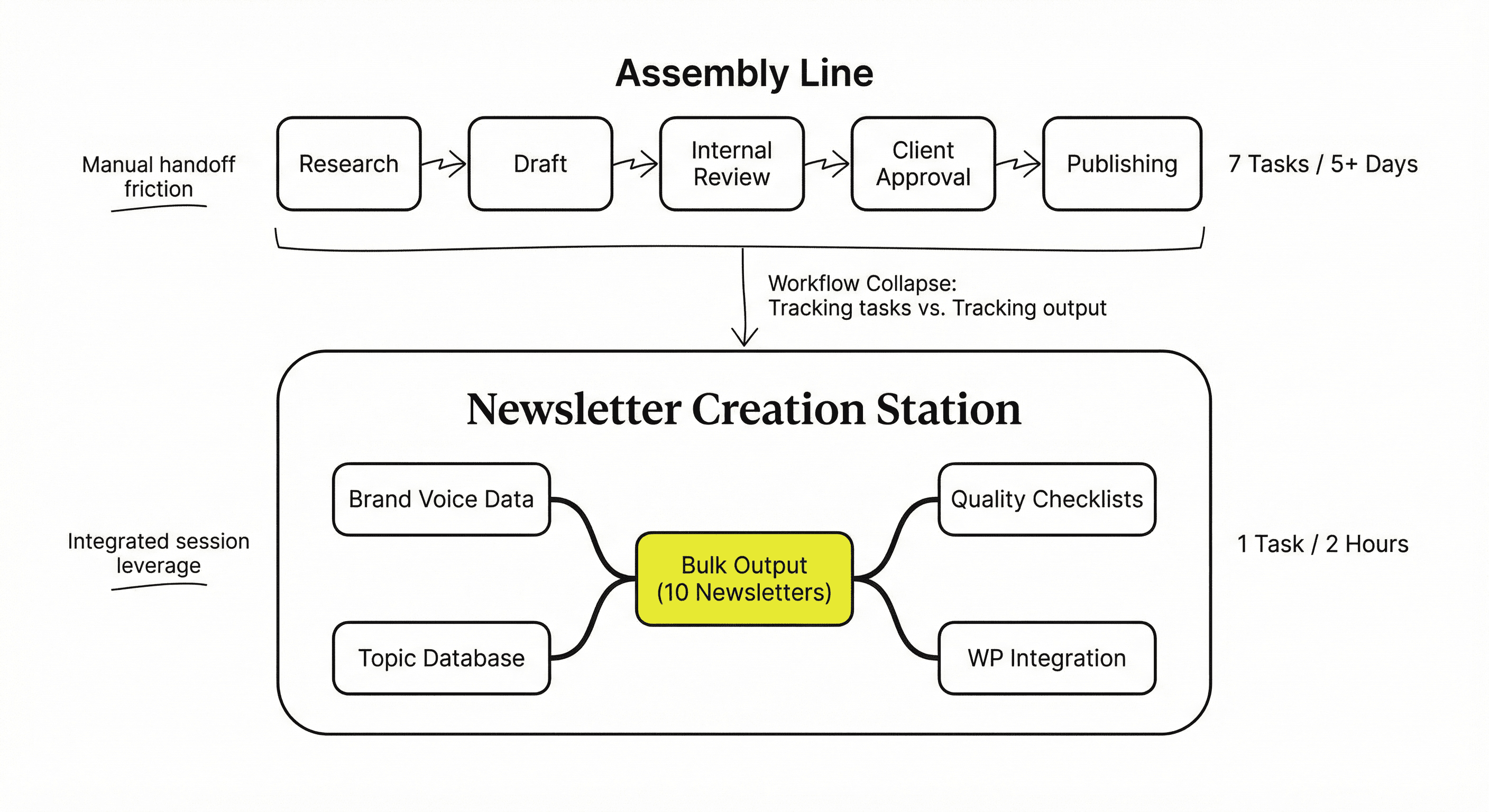
Seven tasks. Multiple handoffs. Days of cycle time.
The New Model: Work Stations
You create outcome-based sessions:
One task: "Complete 10 client newsletters"
One 2-hour calendar block
One primed work station with context, AI layer, and prompts
Jump straight to approval (which becomes more formality than necessity)
The result? What took a week now takes an afternoon.
Why This Matters Now
Here's what's happening: AI isn't just automating individual tasks. It's collapsing entire workflows into single work sessions.
When a marketing manager can generate 10 newsletters in the time it used to take to draft one, the task-by-task tracking becomes theater. Worse, it becomes a liability—tasks that now complete in hours can slip through the cracks because your system wasn't designed to track them.
Companies are spending $15K-$50K building elaborate ClickUp or Asana systems based on task-list thinking. In 18 months, they'll need complete rebuilds.
What a Work Station Actually Looks Like
Let's make this concrete. Here's what we built for a content agency:
Traditional Setup (7 tasks, 5+ days):
Brainstorm newsletter topics
Research and outline
Write first draft
Internal review
Revisions
Client approval
WordPress publishing
Work Station Setup (1 task, 2 hours):
Open "Newsletter Creation Station" in ClickUp. Everything's primed:
Client brand voice and ICP parameters loaded
50 pre-approved topic directions in a database
Quality criteria checklist embedded
Direct WordPress integration
The manager blocks 2 hours. AI generates detailed newsletter drafts with images in the client's voice. She makes light edits. AI reviews against quality criteria and flags gaps. Output logs directly to ClickUp with count (3/10 complete). When she hits 10, task auto-closes.
No approval bottleneck. No handoff delays. No lost tasks.
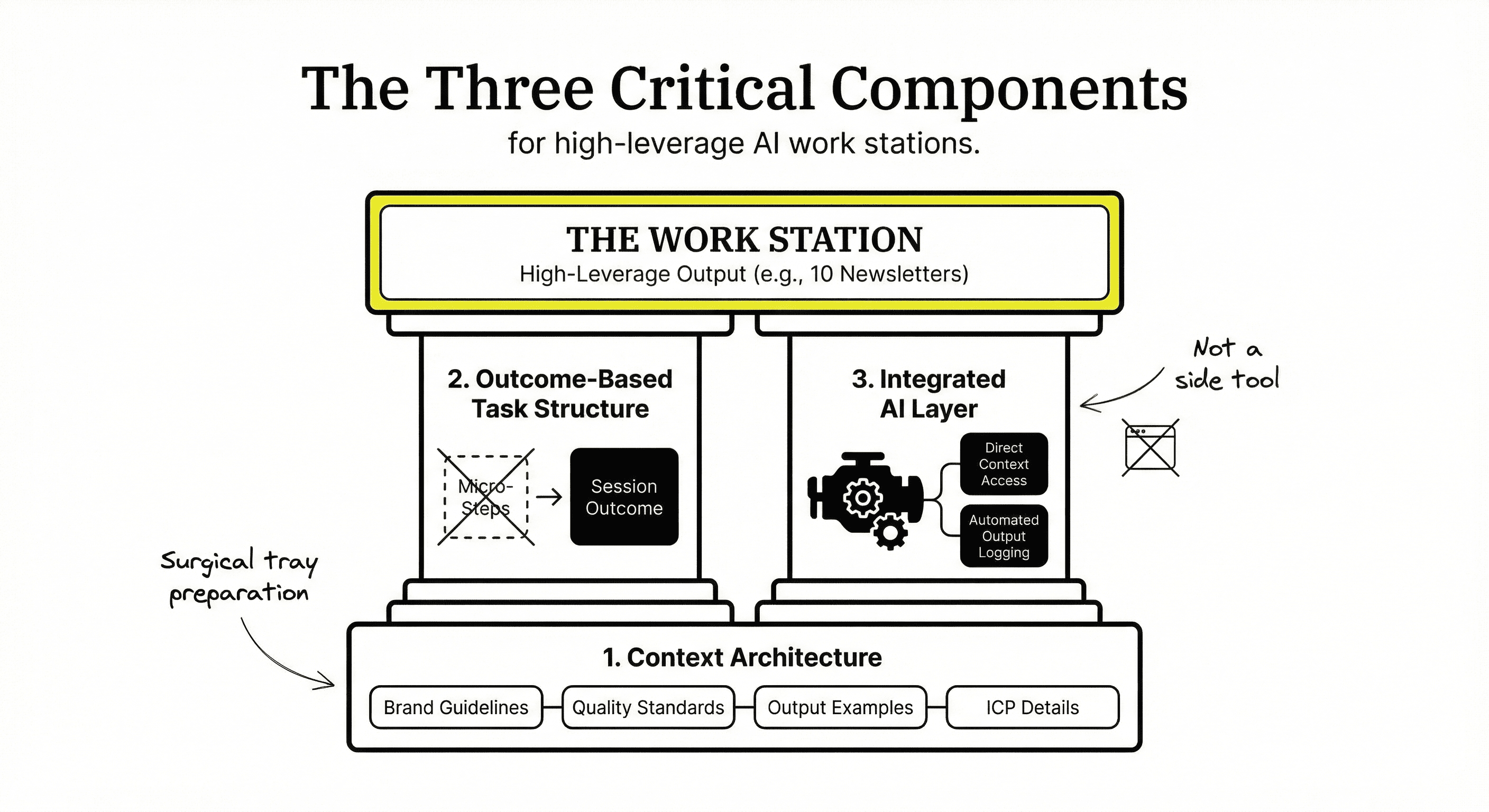
The Three Critical Components
If you're going to make this shift (and you should), here's what your work stations need:
1. Context Architecture
Your work station must have rich context loaded before work begins. Brand guidelines, quality standards, output examples, ICP details. Think of it like setting up a surgical tray—everything in place before you start.
2. Outcome-Based Task Structure
Stop tracking "Create draft 1." Start tracking "Complete 10 newsletters." The task represents the session outcome, not the micro-steps. AI handles the steps. You track the output.
3. Integrated AI Layer
This isn't ChatGPT in another tab. The AI lives inside your PM tool, has access to your context, can log outputs directly, and follows your quality frameworks. It's infrastructure, not a side tool.
What Happens If You Don't Adapt
I've seen this movie before.
Companies spend months building intricate task-based systems. Everything's documented. Every handoff mapped. They're proud of it.
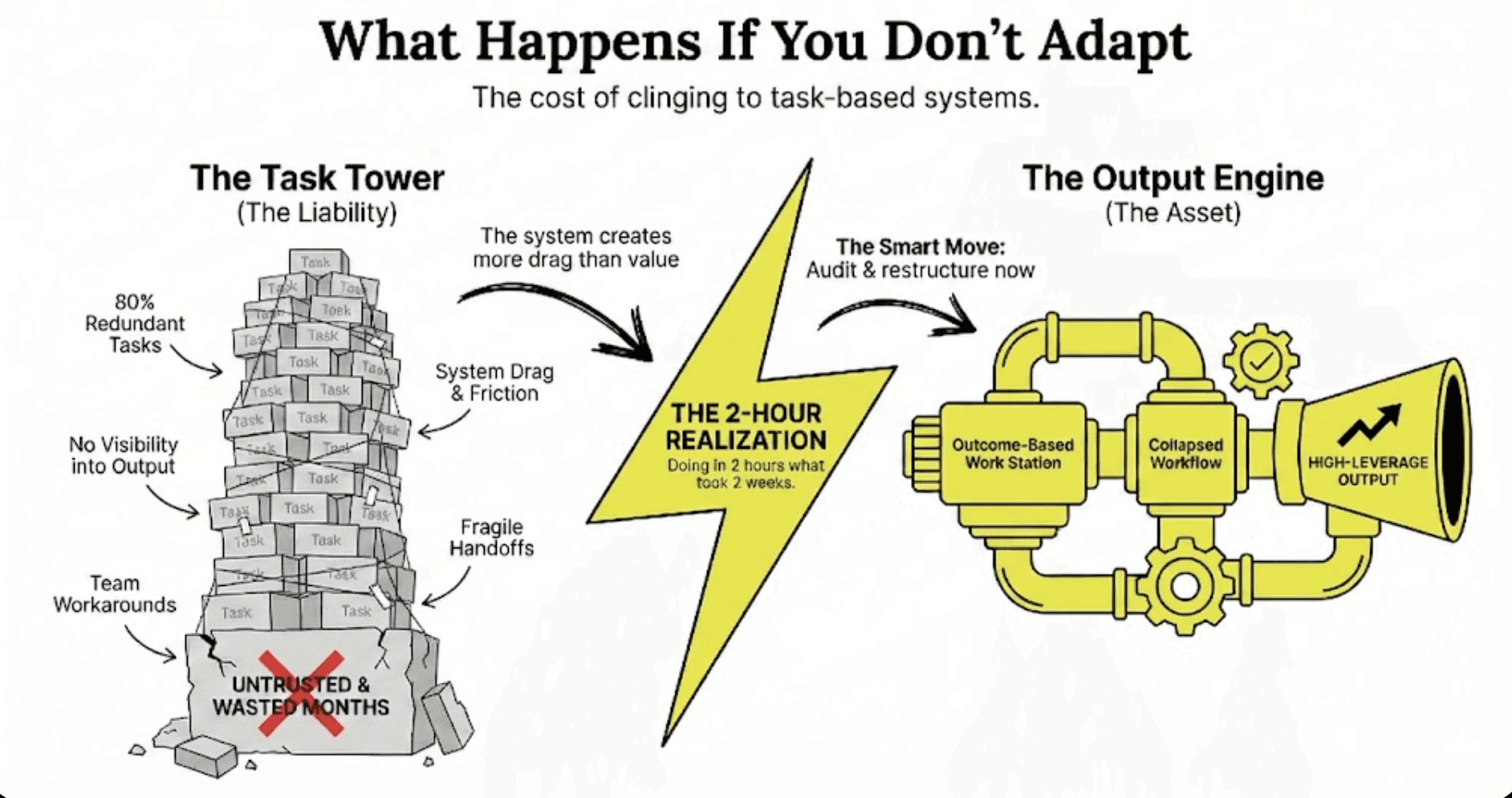
Then someone discovers they can do in 2 hours what used to take 2 weeks.
Suddenly:
80% of tasks are redundant
The system creates more drag than value
Management has no visibility into actual output
The team starts working around the system
You end up with an expensive project management tool nobody trusts.
The Bottom Line
The companies winning in 2026 aren't the ones with the most tasks in their PM tool. They're the ones who restructured their systems around outcome-based work stations before they were forced to.
This isn't about buying new software. It's about fundamentally rethinking how your operations infrastructure tracks and enables work.
Most teams will wait until the pain forces change. By then, they've burned months of productivity and tens of thousands on systems that need rebuilding.
The smart move? Audit your current setup now. Identify which workflows can collapse into work stations. Build the infrastructure before you need it.
Ready to Future-Proof Your Operations?
We're helping a select group of companies navigate this exact transition—restructuring their operational systems from task-based to work-station-based before it becomes an emergency.
If you're running a business doing $500K+ annually and you can feel this shift coming, let's talk.
Book a 30-minute ops assessment
We'll review your current setup, identify which workflows are ripe for transformation, and map out what a work-station-based structure would look like for your business.
No pitch. No pressure. Just a clear-eyed assessment of where you are and what needs to change.
See you next Thursday,
Olivia Parkes
Founder, The Systems Boss
P.S. If you're thinking "this sounds complicated," that's exactly why you should book the call. The companies that get this right make it look simple. The ones that don't spend months in expensive rebuilds.
